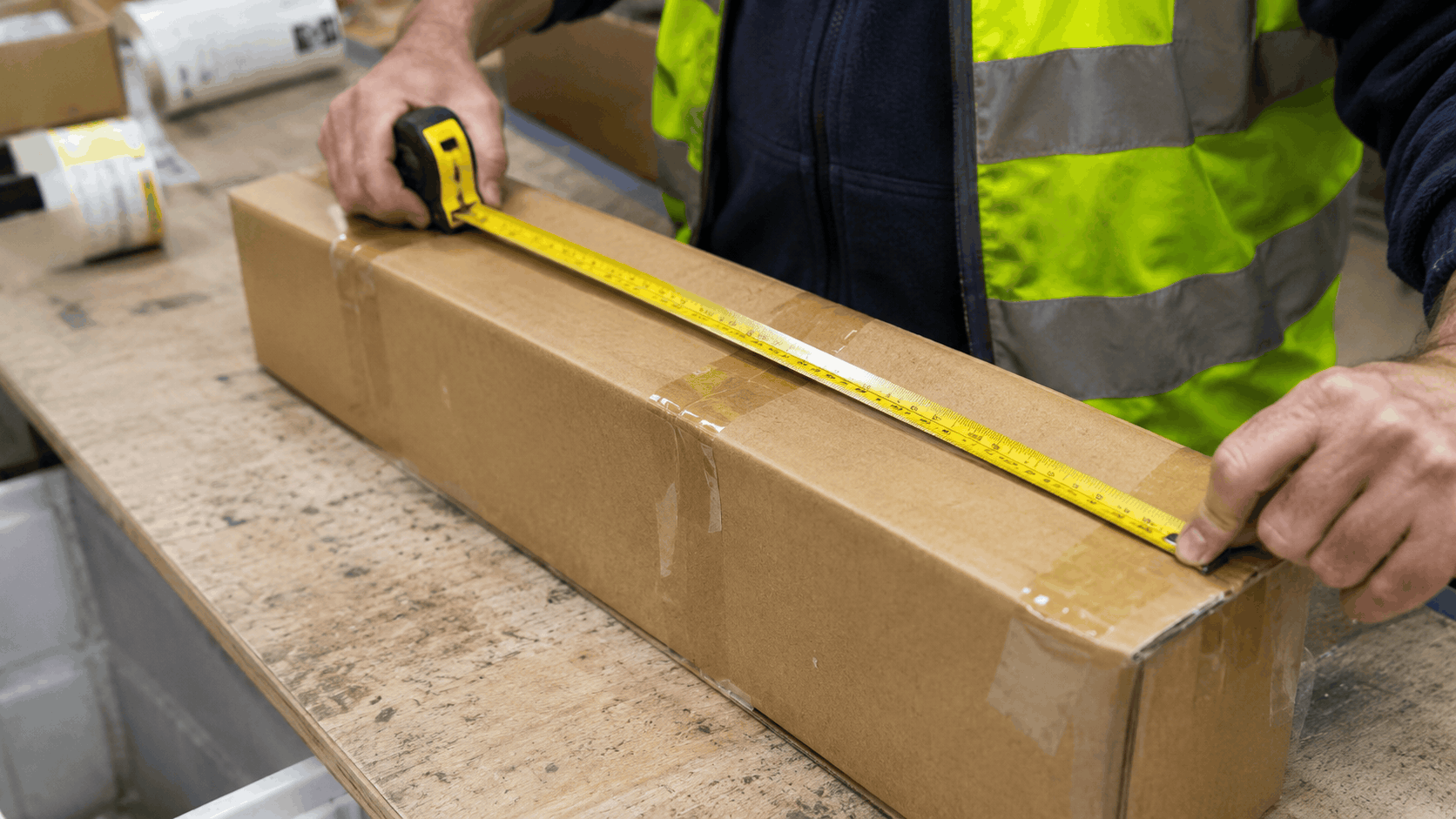
Large parcel size and how to measure a long or oversized parcel
Large parcel size explained for businesses. How to measure length and girth, what counts as long or oversized, and when to ask your local CSM branch for help.
Published
Most couriers are set up for boxes that one person can carry. Once an item gets long, wide or awkward, the rules change: the price can go up, a different service may be needed, and a parcel that is too big can be refused. Knowing the parcel size limits before you book saves a lot of time. This guide explains what counts as a large parcel, how to measure one correctly, and what to do when an item does not fit a standard service.
What Counts as a Long, Large or Oversized Parcel?
There is no single national definition. Each carrier sets its own limits, and a parcel is treated as large or oversized as soon as it passes one of them. The measures that matter are usually the same:
- The length of the longest side
- The second longest side
- Length and girth combined, which captures how bulky a parcel is
- The weight of the parcel
In practice, a parcel is often called long once it passes about a metre in length, large when its combined size triggers extra handling or a surcharge, and oversized when it nears or passes the carrier's maximum. The terms overlap, so the figures that matter are the ones in your carrier's published limits, not the label.
As an example, UPS publishes limits for its small parcel services of up to 70kg, up to 274cm in length and up to 400cm in length and girth combined. Other carriers have different figures, so check the limits for the service you plan to use.
How to Measure a Parcel
Measure the parcel as it will travel, in its final packaging, not the item on its own. Packaging adds length, width and height, and carriers measure what they collect.
- Measure the longest side. This is the length.
- Measure the other two sides, the width and the height.
- Work out the girth, which is twice the width plus twice the height.
- Add the length and the girth to get the combined size.
- Weigh the parcel.
For example, a parcel that is 120cm long, 30cm wide and 20cm high has a girth of 100cm (2 x 30 plus 2 x 20). Its length and girth combined is 220cm. UPS uses the same formula: length plus two times the width plus two times the height. Round measurements up, not down, because a few centimetres can move a parcel into a higher band.
Why Parcel Size Changes the Price and What a Courier Will Accept
Size affects a delivery in three ways.
Pricing
Carriers can charge extra for parcels that pass a length, combined size or weight limit. Some also set a minimum billable weight for large parcels, so a light but bulky parcel is charged as if it were heavier. UPS, for example, treats a package as a Large Package once its length and girth exceed 300cm, with a minimum billable weight of 40kg.
Handling
Long and awkward parcels often cannot go through standard sorting equipment in the same way, so they may be routed and handled separately. That can affect transit and packaging requirements.
Acceptance
Above the maximum limits a carrier may refuse a parcel, or accept it only at a much higher charge. If your parcel is near a limit, ask before you book, not after it has been collected.
Accurate dimensions are the single biggest factor in avoiding surprises. A parcel that turns out to be larger than declared can be re-priced or held.
Items That Usually Travel as Long Parcels
Long parcels are a regular part of business shipping. Common examples include surfboards, skis, pool cues, fishing rods, rolled materials, display stands, curtain poles, flooring and furniture parts. Many of these are light for their length, which is why combined size and billable weight matter as much as the weight on the scales.
How to Pack Long and Awkward Items
A long item is more likely to bend, snap or dent at the ends than a compact one, so packaging matters. If you are working out how to send a long parcel, start here.
- Use a rigid outer box or tube that is long enough for the whole item, not a flexible bag.
- Add internal support so the item cannot flex or slide, and protect the ends.
- Fill empty space so the contents do not move.
- Avoid loose wrapping. Items that are not fully boxed, or that are in plastic wrap, wood or metal, can attract extra handling charges with some carriers.
- Attach the label flat on the largest face and keep a copy of the delivery details inside.
Common Measuring Mistakes
- Measuring the item and forgetting the packaging
- Rounding down instead of up
- Leaving out the girth, so the combined size is wrong
- Not weighing the packed parcel
- Assuming a standard service accepts the item because a similar one went last month
When a Parcel Is Too Big for a Parcel Service
Some loads are beyond what a courier parcel network will take. If the length and girth pass the carrier's maximum, or the weight is well over the limit, you will usually need a different service.
Palletised goods may suit a pallet network, and our guide to how pallet delivery works explains when that makes sense. For very large or heavy cargo, freight by road, sea or air may be the answer, and we cover the options in our guide to heavy shipments.
How CSM Handles Long and Large Parcels
CSM classifies items over 100cm in length as long parcels. It offers delivery options for items up to 3 metres long, subject to the item's dimensions, weight, destination and carrier acceptance. This does not mean every item up to 3 metres qualifies for a standard parcel service. CSM routes each large parcel through the most appropriate carrier network for the item's dimensions, weight and destination, and every parcel is tracked from collection to delivery through your online account. For very large shipments, air, sea and road freight are available through CSM's associate companies AFFA and Sandrair.
When you book, enter the full length, width, height and weight in the Send a Parcel section of your account, and CSM generates pricing from those details. Charges depend on size. A large package surcharge applies to packages over a combined length and girth of 300cm, and packages over 400cm combined need an alternative service and quote from your local CSM branch.
CSM's published service information lists an over-maximum-size surcharge for packages exceeding 70kg or 270cm in length. Acceptance depends on the carrier and service, so check with your local CSM branch before booking. Additional handling can apply to packages over 25kg, over 110cm in length, with a second longest side over 70cm, or not fully encased in cardboard. Your account manager will advise on charges and packaging before collection.
If you are unsure whether an item counts as a long or large parcel, speak to the team before you book. You can read more on our large and fragile parcel delivery page, or contact your local CSM branch with your item's dimensions and destination.
FAQs
What counts as a large parcel size?
There is no single standard, because each carrier sets its own limits. A parcel is usually treated as large when its longest side, its combined length and girth, or its weight passes a threshold that triggers extra handling or a surcharge. With CSM, a long parcel is any item over 100cm in length, and a large package surcharge applies above 300cm in length and girth combined.
How do I measure a parcel?
Measure the packed parcel, not the item. Record the length of the longest side, then the width and height. The girth is twice the width plus twice the height, and the combined size is the length plus the girth. Weigh the parcel as well, and round measurements up.
What is the maximum parcel size I can send?
It depends on the carrier and service. UPS lists limits of 70kg, 274cm in length and 400cm in combined length and girth for its small parcel services. CSM may accommodate items up to 3 metres long using an appropriate service, but its published information lists an over-maximum-size surcharge above 270cm in length. Ask your local CSM branch to confirm acceptance and charges for your parcel.
How do I send a long parcel?
Pack the item in a rigid box or tube that supports its full length, measure and weigh the packed parcel, and book with a courier that accepts long items. With CSM, log in, choose Send a Parcel, enter the full dimensions and weight, print the label and arrange a collection.
Does a larger parcel cost more to send?
Usually, yes. Carriers can add charges for long, heavy or bulky parcels, and some bill a minimum weight for large ones. Your CSM account manager can explain the charges that apply to your parcel before it is collected.
Can I send an oversized parcel internationally?
Yes, in many cases. CSM provides oversized parcel delivery UK wide and to international destinations for long and large parcels, and your account manager can advise on the service for your destination and any customs paperwork. Contact your local CSM branch to confirm what is possible for your item.
Further Reading
- A guide to correctly labelling parcels - getting the label right first time
- How do I know my parcel is safe when shipping with CSM? - what happens to a parcel in transit
- How next day delivery works in the UK - cut-off times and what affects delivery
Related articles

A business guide to shipping to the USA from the UK
Shipping to USA from UK explained for businesses. Duties, documents, delivery options and what has changed, plus when to ask your local CSM branch for advice.

EU Product Identifiers (PIDs) 2026: What UK Businesses Shipping to the EU Must Know
Product Identifiers are now mandatory for low-value B2C parcels into the EU. Find out what PIDs are, how to format them and how to avoid customs delays.

What to look for in a B2B parcel delivery service
B2B parcel delivery explained for UK businesses. What to look for in accounts, collections, tracking and support, and when to ask your local CSM branch.
How much does pallet delivery cost in the UK?
Pallet delivery cost and how it works for UK businesses. See what affects the price, the speeds available and when to ask your local CSM branch for a quote.
Personal service at every stage of the process.
Get started today with a logistics partner you can rely on.